
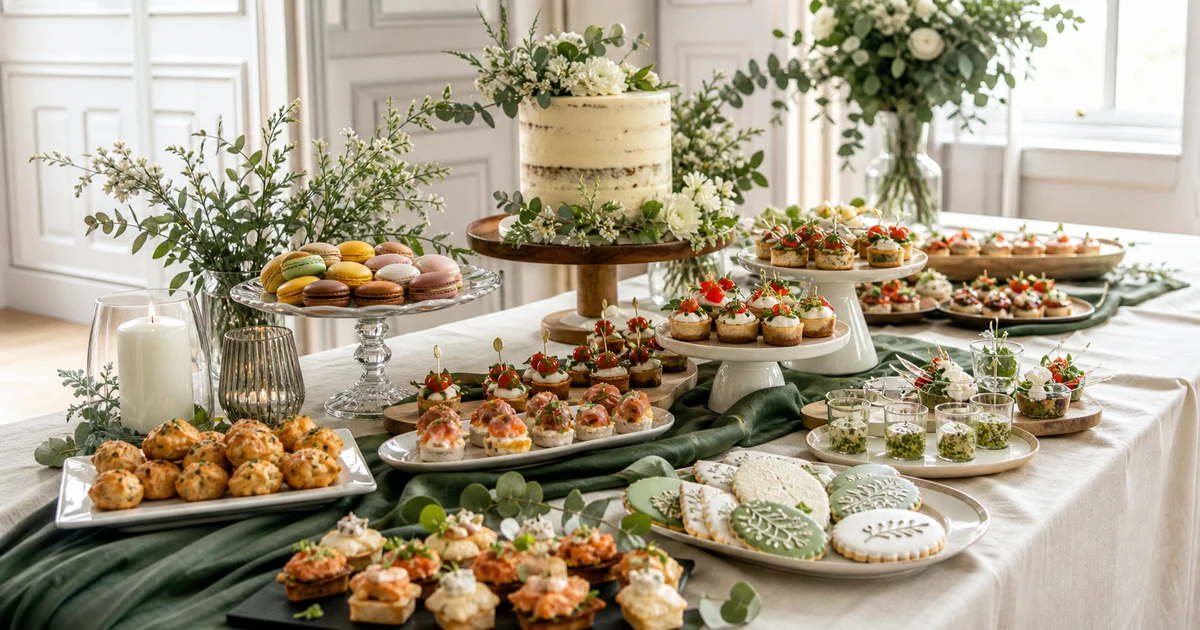
Organising a dinner-style aperitif in Arras is not something you improvise on the morning itself. Between the number of guests, the length of the reception, the budget and the dietary constraints, success comes down to a few decisions taken in the right order. This practical guide walks through the method, from the initial framing to the service, so that your Arras buffet is generous, smooth and free of nasty surprises, whether the party is held at home, in a rented hall or at the office.
Framing your dinner-style aperitif in Arras before ordering
Before talking about canapés, you have to define the role of the buffet. An aperitif that opens the evening is not planned like a standing dinner meant to replace the meal, and this distinction shapes everything else, from the budget to the quantities. To picture a complete, bespoke service, the featured caterer listing in the guide is a useful reference, with its dinner-style aperitifs, macarons and personalised pieces. So start by setting the frame, on a single page, before any quote.
Telling a light aperitif from a standing dinner
A light aperitif accompanies a few drinks before sitting down; you mostly plan cold bites, a few hot pieces and something to nibble without spoiling the appetite. A standing dinner, by contrast, has to make up the whole meal, with a savoury then sweet progression and more substantial pieces (verrines, mini-dishes, skewers). Clearly naming what you want avoids the main Arras pitfall: a buffet too light for an evening that stretches on, or too rich for a simple drinks reception.
Setting a realistic budget from the start
The budget per person is always reasoned against the chosen format and the length. A one-hour reception does not call for the same investment as a four-hour event that stands in for dinner. Set a range before consulting, then ask what it really covers (number of pieces, service, drinks, equipment), because two quotes at the same headline price can hide very different services. This financial framing will save you precious time when comparing.
Listing the constraints of the venue
A reception venue imposes its rules before the recipes do. Note the available floor space, the furniture, the access (floor, lift, parking), the presence of a water point, a fridge and sockets to keep dishes warm. In Arras as in the towns of the urban community, a village hall does not offer the same options as a garden or a company space. These practical elements shape the choice of pieces as much as the guests' tastes.
Working out the quantities for a dinner-style aperitif
Once the format is set, the most frequent question concerns the quantities per person. The useful rule is to count a number of pieces according to the length and the role of the buffet, then add a safety margin. The same reasoning about pace and variety applies to a seated meal, as detailed in our article on choosing an address for a group in Arras. The table below gives simple markers to size your order.
| Reception format | Quantity marker per person |
|---|---|
| Short aperitif (1 h, before a meal) | 5 to 7 savoury pieces, 1 drink per hour |
| Light dinner-style aperitif (2 h) | 10 to 12 pieces, 2 to 3 of them hot |
| Standing dinner (the buffet is the meal) | 14 to 16 savoury pieces, 2 to 3 sweet |
| Long reception (over 3 h) | 16 pieces and more, refreshed platters |
Adapting the pieces to the season
The seasonal pieces hold better and often cost less. In summer, favour fresh verrines, crunchy vegetables and skewers; in winter, hot pieces, pastries and simmered bites warm up a reception. An Arras caterer who works the Artois terroir will steer you towards what is at its best on the day, rather than a catalogue fixed all year round. This is where local knowledge makes a real difference.
Planning drinks and water in quantity
The soft drinks are too often underestimated. Count at least one drink per person per hour, with a large share of water, soft drinks and juices, especially if there are children, drivers or people who do not drink alcohol. Also plan ice, enough glasses and a dedicated space so as not to clutter the food buffet. A reception rarely runs short of canapés; it often runs short of cold water.
Handling leftovers and packaging
Anticipating the buffet leftovers avoids waste and health risks. Ask the caterer for suitable containers, a clear indication of what keeps and for how long, and what must be eaten on the spot. Pieces based on cream, raw egg or fish cope badly with waiting. Good packaging, planned at the time of ordering, turns a surplus into an advantage rather than an end-of-evening chore.
Choosing a caterer for your dinner-style aperitif in Arras
Choosing the caterer in Arras comes down to what the service really includes, not the price per head alone. The caterers in Arras category gathers several approaches, from the takeaway platter to the full service with staff and equipment. Compare on equal terms: ask each one for a detailed quote covering the same items, so you line up genuinely comparable offers.
Reading a quote line by line
A detailed quote separates the pieces, delivery, setup, tableware, staff, drinks and clearing up. A pricier proposal can end up cheaper once service and equipment are counted, while a headline rate can turn out to be bare. Also check the deposit, change and cancellation terms, which protect both sides. This careful reading is the best safeguard against last-minute surprises.
Flagging allergens before confirming
The major allergens (gluten, eggs, milk, tree nuts, fish, shellfish, soy, sesame) slip easily into small pieces without being visible. Flag them before confirming the order, never at service time, and ask the professional what can really be guaranteed, including traces in the workshop (mandatory information under EU Regulation 1169/2011). Then pass those answers on to the guests concerned rather than improvising home-made labels.
Preparing a clear, shareable brief
A good caterer brief fits on one page and can be shared without comment: date, venue, timing, number of adults and children, type of event, budget, allergies, desired style and any visual theme. For personalised pieces (decorated shortbread, a cake), add the exact text, the colour palette and the number of portions. The more precise the brief, the more accurate the quote, and the fewer back-and-forths before the reception.
Nailing the service and setup of the dinner-style aperitif
On the day, a good service plan counts as much as the quality of the pieces. A buffet is thought of as a space: the table must stay accessible without a bottleneck forming in front of a single dish, and the flow must stay smooth even when everyone helps themselves at once. Plan the layout in advance, on paper, before the guests arrive.
Organising the table and the flow
Splitting the buffet zones avoids queues: separate drinks, savoury bites and desserts into distinct points, even placing them back to back to double the access. Clear a defined path, leave room to set down a glass and a small plate, and plan a side table for empty containers. This discreet logistics is what tells a pleasant reception apart from a tight scrum around a single table.
Holding temperatures during the reception
The cold chain and keeping food warm decide both comfort and safety. Fragile pieces stay cool until the last moment and only come out in waves; hot preparations wait for service on suitable equipment. Nothing gains from sitting for hours at room temperature. A professional caterer will advise on transport, platter-by-platter refills and the maximum exposure time for each type of piece.
Welcoming a varied crowd
A varied crowd is planned for at the ordering stage. Children, older guests, vegetarian or alcohol-free diets: a few simple options are often enough for everyone to find their place without doubling the whole buffet. Think of pieces that are easy to pick up standing, a slightly lower table for the youngest and discreet signage for specific preparations. These low-cost touches are the ones your guests remember best.
0 comment
Share your thoughts with other readers.
Leave a comment
Create a free account or sign in to comment.